We like to describe Naples as chaos incarnate. It has a life of its own, that seems to head in every direction at once, but then comes together into a sort of untouchable harmony that energizes your soul. And because I would love to let you know more about the city, we collected together our favorite quotes about Napoli.
In the shadow of Mt. Vesuvius, Naples has inspired writers and artists for centuries.
To recognize this unique city, here are the best quotes about Naples:
Rome is stately and impressive, Florence is all beauty and enchantment, Genoa is picturesque, Venice is a dream city, but Naples is simply — fascinating. – Lilian Whiting
Naples is curiously chaotic and, if I’m honest, a bit dilapidated. It certainly has a ‘lived-in’ look. It’s alive, it’s vibrant, it’s a little bit dirty, it’s busy, and I loved it. – Paul Hollywood
I won’t say another word about the beauties of the city and its situation, which have been described and praised often. As they say here, “Vedi Napoli e poi muori! See Naples and die!” One can’t blame the Neapolitan for never wanting to leave his city, nor its poets singing its praises in lofty hyperboles: it would be wonderful even if a few more Vesuviuses were to rise in the neighbourhood. – Johann Wolfgang von Goethe
Here we are at last. The Italian proverb says “See Naples and die” but I say, see Naples and live; for there seems a great deal worth living for. – Arthur John Strutt
Naples is the flower of paradise. The last adventure of my life. – Alexandre Dumas
I have a concept of Naples that is not so much of a city per se but rather an ingredient of the human spirit that I detect in everyone, Neapolitan or not. The idea that ‘Neapolitanism’ and mass ignorance are somehow indissolubly linked is one that I am prepared to fight with all the strength I have. Quite simply, I refuse to believe that the living conditions of a population can only be improved at the cost of annihilating everything human in their way of life. Indeed, there are times when I think that Naples represents the last remaining hope for the human race. – Luciano De Crescenzo
I exist only because inside of me and above all else I am only and above all a Neapolitan. Naples exists inside of me, and always will. Fortunately for me there is this treasure that I have inside of me and, when I need it, then I pull it out. – Sophia Loren
…the city of Naples was like this: wonderful from a distance, but when seen close up, it was fragmentary, indefinable, and coarse… – Franco Di Mare
Naples sitteth by the sea, keystone of an arch of azure, Crowned by consenting nations peerless queen of gayety: She laugheth at the wrath of Ocean, she mocketh the fury of Vesuvius, She spurneth disease, and misery, and famine, that crowd her sunny streets. – Martin Farquhar Tupper
He who doesn’t love Naples, has yet to learn how to love life. – Anonymous
Naples is a paradise: in it every one lives in a sort of intoxicated self-forgetfulness. It is even so with me: I scarcely know myself; I seem to myself quite an altered man. Yesterday I said to myself, “Either you have always been mad, or you are so now.” – Johann Wolfgang von Goethe
Are there any other quotes about Naples that you love?
Naples lives on its traditions, legends and popular beliefs. On its stories, which have been told for centuries and which every good Neapolitan truly believes. To feel like citizens of Naples, you cannot do without listening to these evocative stories, the stories that come from our past.
Naturally, Naples offers a lot of interesting places to see and visit, but it is also fun to get away from the usual routes and devote yourself to the most interesting things to do in Naples today. Put yourself in the shoes of the Neapolitans and live in first person the most intriguing Naples attractions and experiences connected to what has always accompanied the spirit of these people: tradition, charming popular beliefs and religious fervor (a religion that includes football, as Naples has had Maradona, the hand of God).
Cross Piazza del Plebiscito with your eyes closed
The purpose of this game is managing to go between the equestrian statues in the center of the square, sculpted by Antonio Canova and depicting Charles III of Bourbon and Ferdinand I of the Two Sicilies (the statue of the latter monarch is attributed to Antonio Calì). Rules of the game: close your eyes or wear a blindfold. Procedure: starting from the gate of Palazzo Reale, walk straight for about 170 meters. Do not be surprised if, on opening your eyes, you realize not only that you have not managed to cross the space between the two statues, but that you are somewhere else entirely. According to legend, it is all Queen Margherita’s fault: she is said to have granted a pardon to the prisoners of the Kingdom who passed this test, however, a curse launched by the Queen herself prevented the competitors from being successful. As a matter of fact, the particular conformation of the square, with its surface of not perfectly linear cobblestones, hinders walking in a straight line, making this a very difficult thing to do in Naples with kids, especially during the night.
A scenic view of Piazza del Plebiscito
Leaving a “suspended” coffee
A symbol of Neapolitan generosity, the suspended coffee is a custom born in Naples after the war, when in a period of great crises, the solidarity of the Neapolitans became more intense. Upon entering a bar, people paid for two espressos, one for themselves and one for those who wanted one, but who could not pay for one. A tradition that is still perpetuated and that has given rise to a blueprint of supportive purchases even outside the Neapolitan borders and in other contexts: books, clothing, and food.
Coffee and sfogliatella in a café in Naples
What a beautiful thing is a day at the Gaiola
In front of the Posillipo hill, the Gaiola emerges: it is an islet that is part of the protected marine area Parco Sommerso della Gaiola, which can be reached on foot from the Marechiaro village. This Naples attraction is wrapped in an aura of mystery and sinister legends that have developed since Roman times: the Neapolitans suggest that it brings “jella” (bad luck), but they continue to go there assiduously. In fact, the island is enchanting and it is worthwhile forgetting about the rumors and diving into the crystal-clear water, admiring the seabed and the underwater treasures.
The Gaiola Island, part of the ‘Underwater Park of Gaiola’, a protected marine reserve
Adopt a capuzzella at the Fontanelle Cemetery
This is one of the most typical things to do in Naples: the Fontanelle Cemetery, within a tuff quarry in the Rione Sanità, was the common grave of the plague victims of 1656 and of those who died in the cholera epidemic of 1837. Don Gaetano Barbati placed here the skulls and bones of the victims, who became to the people “pezzentelle”, abandoned souls, stranded between the earth and the afterlife. It is a place of great passion and devotion, where the Neapolitans come to adopt a capuzzella (skull); they give it a name, light a candle, and venerate it in exchange for a favor or a lucky number to play in the lotto. And if the favor is not granted? You change capuzzella!
Skulls and bones at the Fontanelle Cemetery
Pilgrimage to Maradona’s votive shrine
Between 1984 and the early 1990s, at every soccer game played at home, the San Paolo stadium the stands would shake, and a roar welcomed the entry onto the field of Diego Armando Maradona. It is difficult to explain what the Argentine phenomenon meant for the city of Naples and its citizens. The golden boy has enchanted the Neapolitans to the point of being almost sanctified; many were the children born in those years who were baptized as Diego, and the whole city is plastered with posters, murals, and small altars dedicated to him. But the best known niche is that of Piazzetta Nilo, on the façade of the bar named after the square: it holds a precious lock of the champion’s hair, some images, and the advice to stop and have a coffee to be told the anecdote of Maradona’s hair by the bar owner.
Naples is one of Europe’s largest and oldest cities. It’s a chaotic, surprising and intense place stuffed with character; modern life and history clash on every street. More so than any spot in Italy, your mantra whilst there will be eat, pray, pizza (and football), sleep, repeat. With sunny islands, ancient history, beaches and a volcano, there’s enough here to fill an entire summer break—especially as you’re likely to lose track of time while wandering through ramshackle alleyways stuffed with the world’s best pizza.
Best things to do in Naples
Visit Pompeii
What is it? You know about Pompeii already, of course, but it’s genuinely overwhelming in real life. Its perfectly preserved streets manage to remain eerie despite rivalling the footfall of Oxford Circus on a Saturday. Why go? Always good to have a reminder that humans are ultimately at the mercy of Mother Nature. Few things say carpe diem like the plaster cast of a corpse who was looting a jewellery shop.
Explore Herculaneum
What is it? Pompeii may have got all the glory but nearby settlement Herculaneum also got completely engulfed by lava, and revealed even better-preserved scenes of everyday Roman life. A row of 12 boathouses, for instance, which were excavated in the 1990s, turned out to be the final hiding place of more than 300 people. Why go? Though still popular with visitors, you get a bit of personal space at Herculaneum. All the better for getting to grips with the astonishingly old suburbia you’re exploring.
Pay respects to the pizza gods at Sorbillo
What is it? One of the few things that all Neapolitans can agree on is that they make the best pizza. You can get the signature chewy, crispy dough all over town but you have to start somewhere, and that should probably be La Pizzeria Sorbillo. Why go? Gino Sorbillo’s dad was one of 21 siblings, all of whom were pizzaiolo. His dough is totally trad but – very unusually for Italy – he messes with convention on the toppings.
Drink like the locals in Piazza Bellini
What is it? Like a meeting post for the young and thirsty of Naples, this bar-lined square bubbles over with students, locals and tourists come aperitivo time (and beyond). There are also some ancient ruins left casually unprotected in its centre. Why go? The walls at Intra Moenia are covered with rows and rows of vintage postcards and curios. Buy one to send home then claim a table outside to sit back and sip while the crowds gather.
Drink coffee in Mexico
What is it? Popular with everyone from local workmen to holidaying hipsters, Caffè Mexico in Piazza Dante is the best coffee bar in town. Stop in for an espresso, which in Naples generally comes sweetened unless you demand otherwise. Why go? Its sunny yellow awning and bright orange espresso machine will perk you up as much as the caffeine does.
Go mad for the Museo d’Arte Contemporanea (MADRE)
What is it? A world-class museum of modern art that’s named after the gothic fourteenth-century church that sits within its walls. Museo d’Arte Contemporanea Donnaregina’s beautiful main building holds site-specific works by Jeff Koons, Anish Kapoor and many other superstars of the visual arts. Why go? You might, at some point, want to gaze appreciatively at something that’s not older than Italy itself.
Feast on fish at Mimì alla Ferrovia
What is it? It’s not just pizza that Neapolitans nail. This seaside city is awash with fantastic seafood, and Mimì alla Ferrovia is a great place to eat a load of it. As well as traditional food done right this local favourite also boasts excellent house wine and staff who could moonlight as Naples tour guides. Why go? One of the restaurant’s many famous customers was legendary tenor (and food enthusiast), Luciano Pavarotti.
Go deeper underground at the Fontanelle cemetery
What is it? Beneath the heat and bustle of Naples’ streets is an old quarry that became a burial site in the seventeenth century when a plague took out 250,000 of the city’s residents. Though the Fontanelle cemetery’s piles of bones are undeniably unnerving, the local tradition of caring for a lost soul’s skull lends the place a very spiritual feel. Why go? Watch for the odd Italian nonna on her way to tend to her designated skeleton in the hope of releasing its soul to heaven in return for a wish.
Get a breath of sea air on the Lungomare
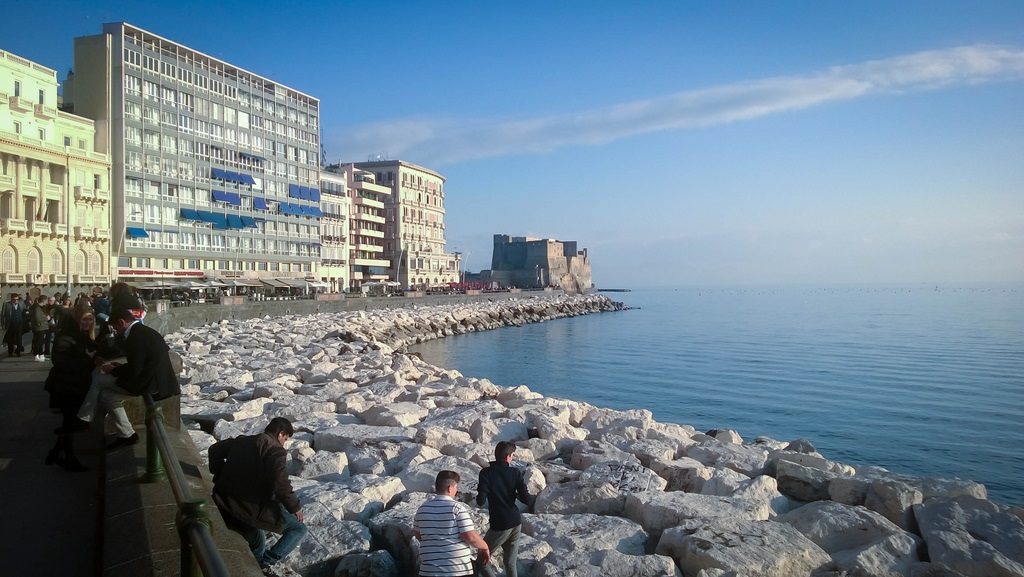
What is it? A 2.5km strip of pedestrianised road that runs along the seafront, providing the perfect stress-free route for a stroll. Stop for lemon granita at the beach kiosks, claim a rock to sunbathe on or stop for a sundowner. Why go? The views of Mount Vesuvius, Capri and Naples itself are spectacular. Add in a colourful sunset and it could be a Studio Ghibli set.
Experience Catholic grandeur at Gesù Nuovo
What is it? Over in the west of the city a spacious piazza is home to the almost brutalist-looking facade of a church called Gesù Nuovo. Its ridiculously opulent interiors will have you wondering whether it wasn’t only Lawrence Llewellyn-Bowen’s hair that was Jesus-esque. Why go? Learn more about Dr Giuseppe Moscati, who dedicated his career in the early nineteenth-century to healing the poor. Thanks to a miracle or two he was made a saint in 1987.
Watch a match at the San Paolo Stadium
What is it? The only belief system to rival that of the church in this town is football, and its much-loved poster boy is Diego Armando Maradona. Go to San Paolo Stadium to watch SSC Napoli and you’ll likely be rewarded with a world-class match; they play in Italy’s top league, Serie A. Why go? When surrounded by 60,000 fans all chanting for a common goal you’re guaranteed goosebumps. Remember to make the pilgrimage to Bar Nilo afterwards to visit the reliquary containing a strand of Maradona’s hair.
Take the funicular to Castel Sant’Elmo
What is it? Though you’re not likely to need the metro during your visit, it’s worth seeking out the funicular lines that shunt residents up to the hilly suburbs. Their colourful carriages are used by 10 million passengers per year. Why go? For the panoramic views from the top. Take the line from Montesanto to Morghen then walk to the medieval Castel Sant’Elmo. The tangle of Naples city centre’s buildings is framed by the sea on one side and Vesuvius on the other.
Take a boat to Procida
What is it? Of the Bay of Naples’ three islands, it’s Capri that is most ridiculously beautiful, but that also means it’s constantly smothered in tourists. Ischia offers thermal spas, but it is Procida’s charming colourful houses and cobbled streets that make it the off-the-radar offshore choice. Why go?Procida seems to want to keep its secret to itself, although it’s popular with napoletani looking for a summer escape from the steaming, chaotic city. .
In the shadow the Vesuvius tourism’s roots run deep: on the imprints of great greek columns refined aristocrats and roman emperors built their sumptuous villas and oasis all along the shoreline of the Gulf.
It is not a coincidence that at the begining of this third millennium the peculiar magic of this civilisation continues to generate new sources of amazement: the recovery of age old monuments and traditions – folklore, gastronomy, genuine cultivation – that were thought irreparably lost, events and shows worthy of the great international circuit, new fodder for artistic and scientific research.
The artistic treasure of Naples to visit are, in fact, to many to count: the historical centre, a patrimony under the tutelage of UNESCO, the palaces, churches, catacombs and underground passageways, the Archaeological Museum, the places of medieval and renaissance power amassed around the Castel Nuovo and Royal Palace, the unforgettable waterfront from Castel dell’Ovo to Posillipo. The hilly area of Vomero offers masterfully restored buildings like the Capodimonte Royal Palace and the Certosa (monastery) of San Martino, museum collections amongst the most important in the world.
A trip through the twentieth century city takes you, among the notable urban and architectural sights, to the rationalist Mostra d’Oltremare, with its park, sports complex and exhibition space. Science is also witness to the recovery of industrial archaeological complexes and the originality of a scientific tradition that renews itself. Unusual and surprising is the exploration of the new homes of contemporary art: monumental structures like the PAN, Palazzo delle Arti Napoli, the MADRE, Museo d’Arte Contemporanea Donnaregina (Donnaregina Contemporary Arts Museum), and the unique artistry of the metro stations that evidence the original horizons of farseeing cultural politics.
Naples, in the final sum, remains, deep in its roots, even with all the difficulties and contradictions inherent to all big metropolitan cities, an extraordinary place to live, admire, and enjoy with all the senses: for the depth of the art and civilisation that has idelibly marked its history; for the mild climate that accompanies day and night the shows, musical and theatrical events, exhibitions, fairs and religious gatherings; for the gourmand possibilites to search out the age old culinary tradition, the seafood and the unique typical products (buffalo mozzarella, pizza, Docg wine, varied and refined pastries) in all their local translations, or for finding fine hidden little.